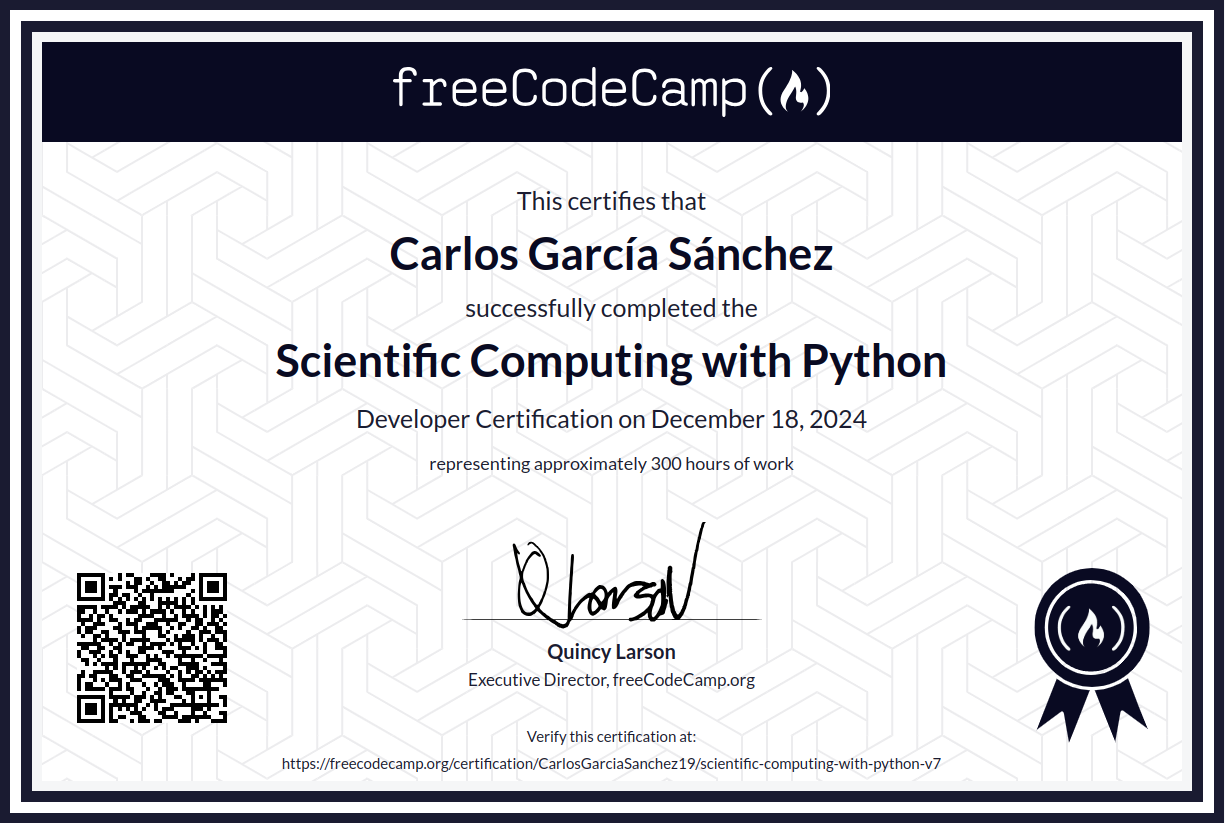
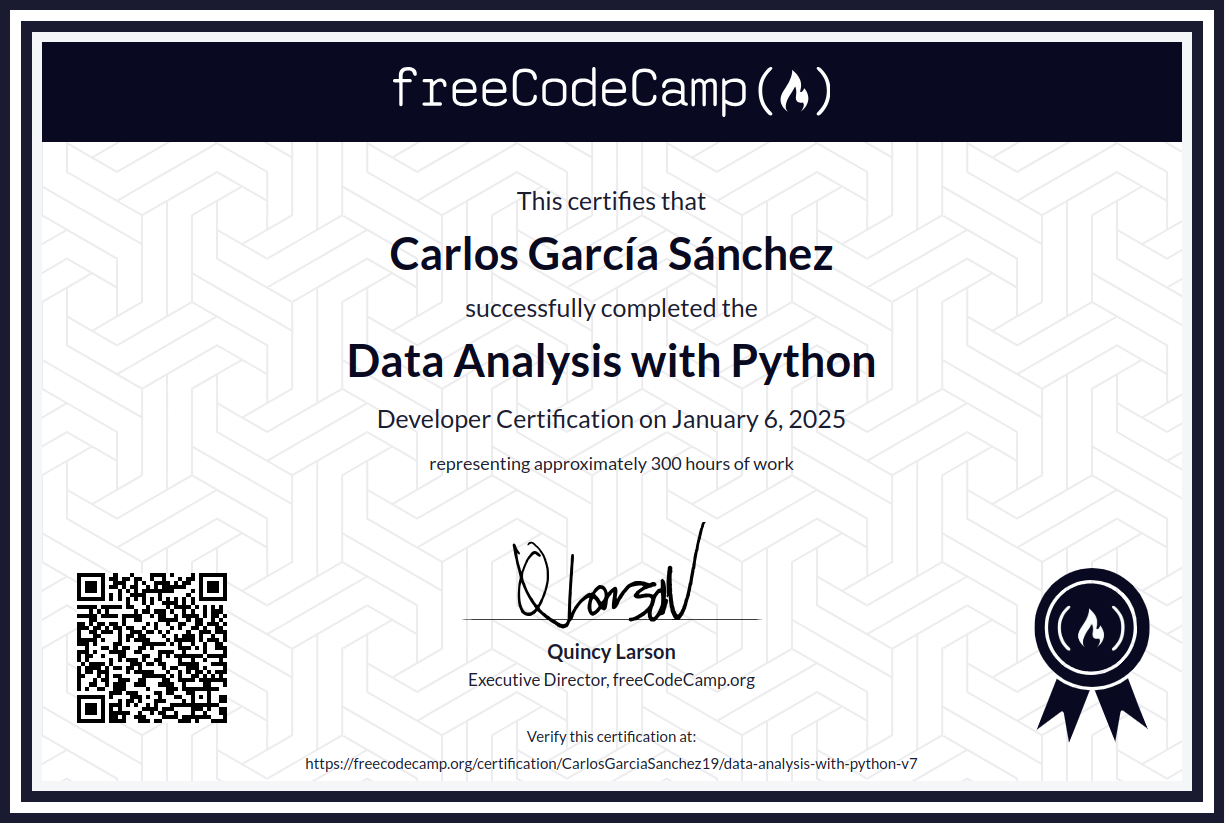
About me
I am a physicist with experience in simulation and mathematical modelling, with a Master's degree in Theoretical Physics from the University of Bologna and currently expanding my programming skills at 42 Madrid Fundación Telefónica. My interest is focused on the development of computational solutions applied to physics and other scientific and computing areas. I have experience with Python, Matlab and C, and I enjoy solving complex problems and optimizing code. I am always looking for new opportunities to keep learning and contributing to innovative projects.
Technologies
C
Python
Matlab
Maple
Experience
Congress organizer
I was within the organizing committee of the INVISIBLES24 congress, which took place in Bologna July 2024. My role was to help with the online broadcasting and other stuff.
Proyects
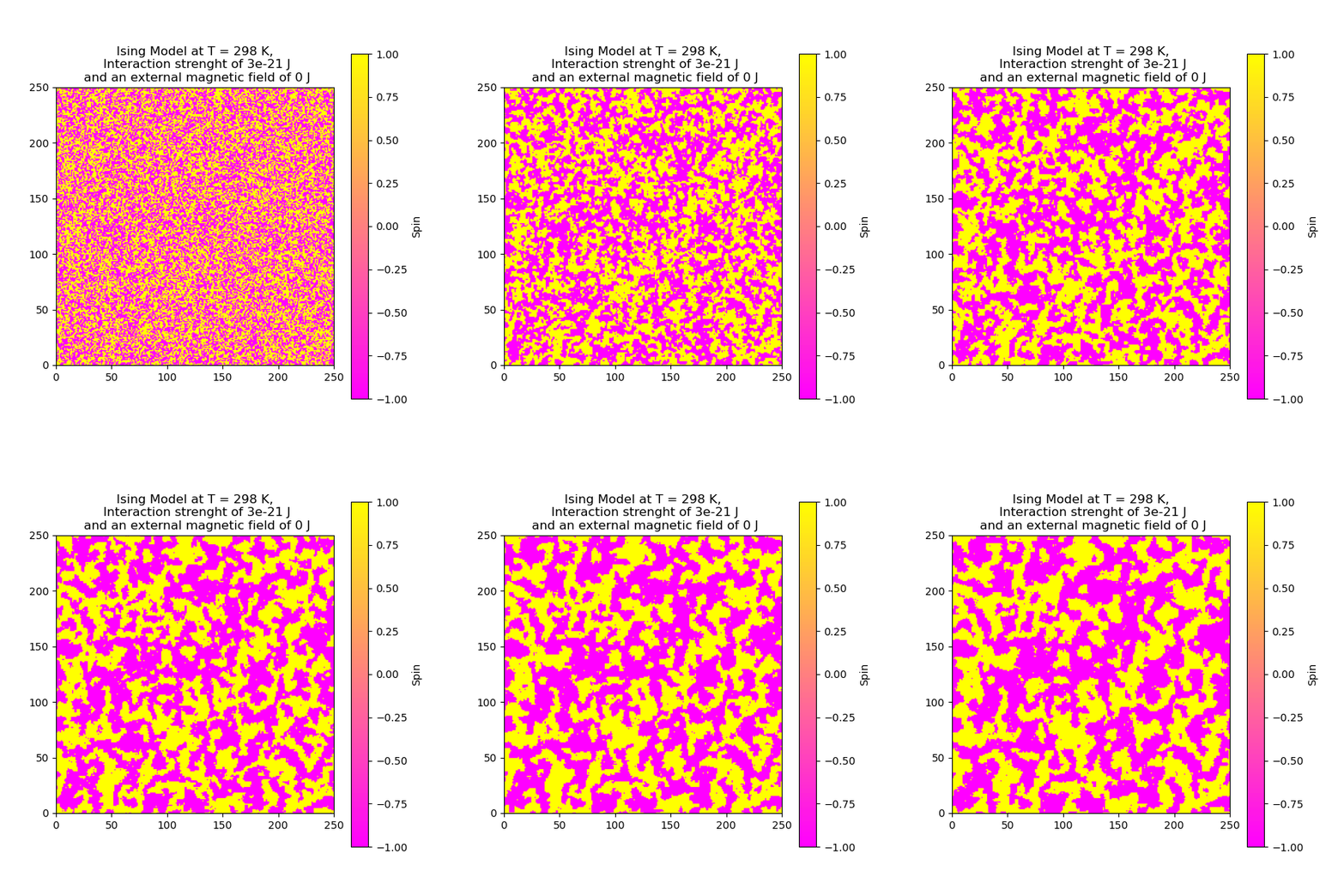
Monte Carlo Ising Model Simulator
This project is a Monte Carlo simulation of the Ising model, a mathematical model of ferromagnetism in statistical mechanics. The program simulates the evolution of a 2D lattice of spins according to the Metropolis algorithm, and it allows the user to change the temperature, the size of the lattice, the interaction strength between spins and the intensity of external magnetic field. The program is written in Python and uses Jupyter Notebook for visualization.
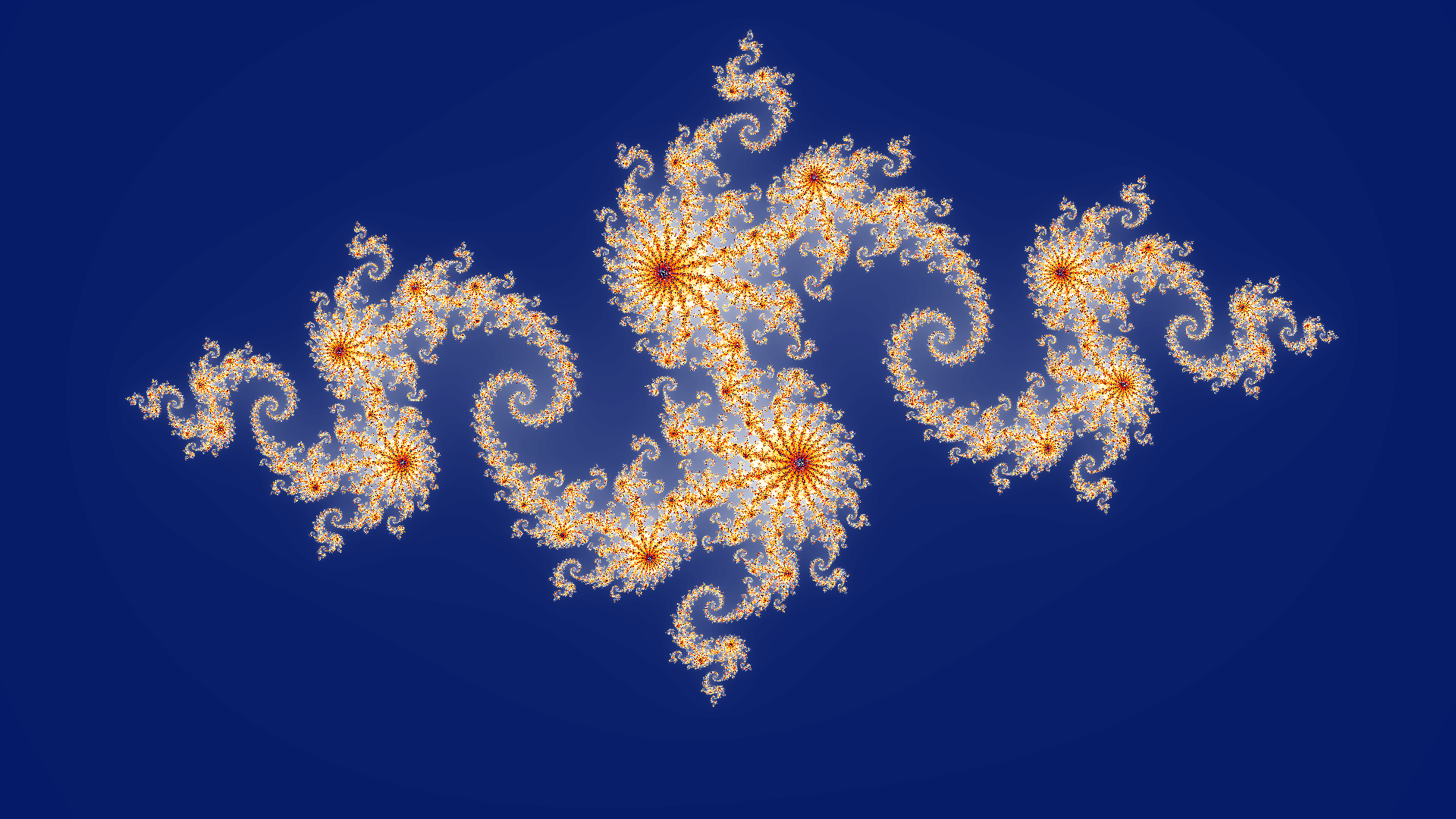
Stack sorting algorithm
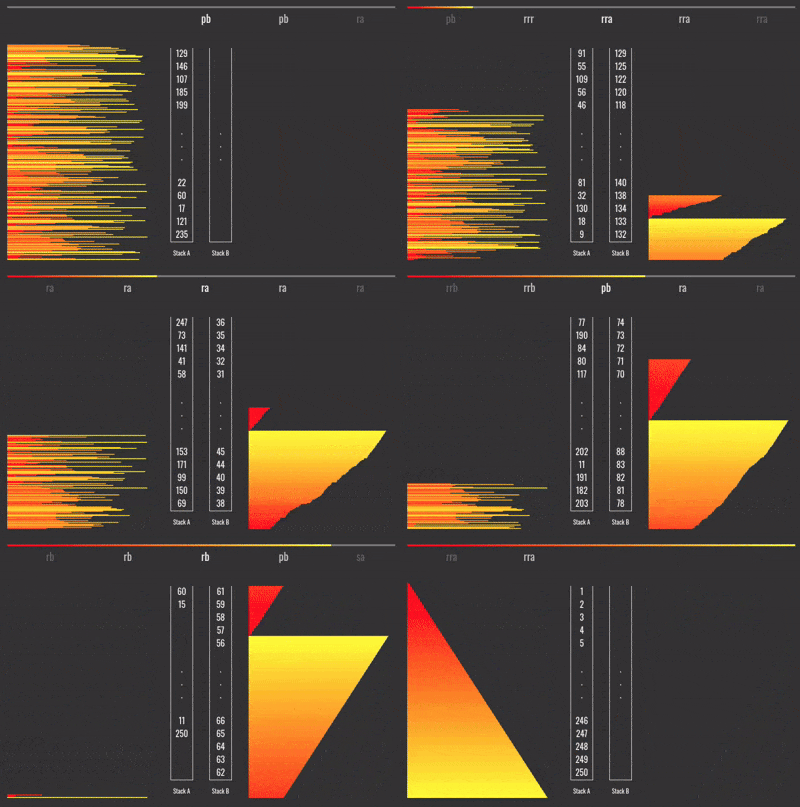
This project implements the Turk Algorithm to sort a stack (a) using an auxiliary stack (b). The algorithm applies a set of predefined operations to manipulate the stacks and achieve a sorted state for a. It also contains a checker useful to validate the instructions provided by the main program push_swap.
Education
Programming school
At 42 Madrid Fundación Telefónica, I am immersed in an innovative peer-to-peer learning environment that fosters problem-solving, self-learning, and collaboration. My focus includes mastering C programming, debugging complex issues like segmentation faults, and creating programs with optimal memory management. Additionally, I strive to develop efficient software solutions by applying best practices in algorithm design and optimisation. Through real-world projects and coding challenges, I am strengthening my expertise in computer science fundamentals and teamwork.
Master's degree in Theoretical Physics
Throughout my master's degree, I acquired a solid foundation in theoretical physics and developed advanced skills in mathematical modelling and simulation. I mastered on quantum field theory, statistical mechanics and I applied numerical methods to solve complex problems in physics. In my Master's thesis I was able to prove that the upcoming LHC long-lived particle experiments are sensitive enough to detect a dark photon that would have diluted the entropy of the universe in its early stages. During this thesis I worked with python, specifically the Matplotlib, NumPy and Pandas libraries. By combining theoretical knowledge with practical experience, I gained a deep understanding of fundamental concepts in physics and enhanced my problem-solving abilities.
Bachelor's degree in Physics
This degree provided me with a solid foundation in physics and mathematics, as well as the opportunity to develop my analytical and problem-solving skills. I studied a wide range of topics, including classical mechanics, electromagnetism, quantum mechanics, thermodynamics, general relativity and particle physics. I also gained experience in experimental physics through laboratory work and research projects. In my final thesis I had the opportunity to calculate the first normal oscillation mode of a non-rotating Swartzschild black hole with its respective Schrödinger-type equation obtained by applying an infinitesimal perturbation in the Swartzschild black hole metric. I was able to both derive this Schrödinger-type equation from the Einstein equations, and to calculate numerically the frequency of the first normal mode of oscillation, all using Maple. This project was a great opportunity to apply my theoretical knowledge to a complex problem and to develop my skills in mathematical modelling and equation solving.